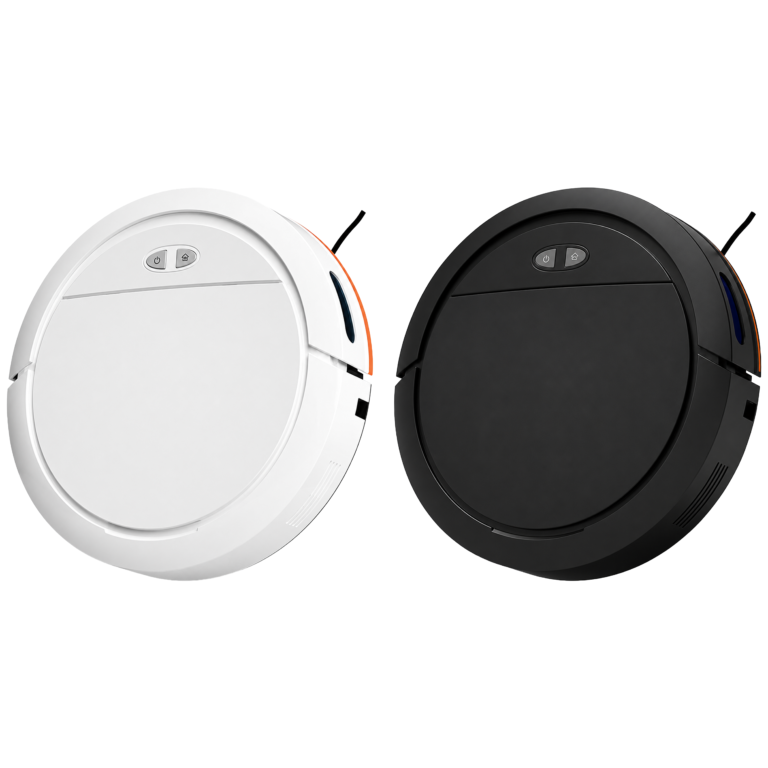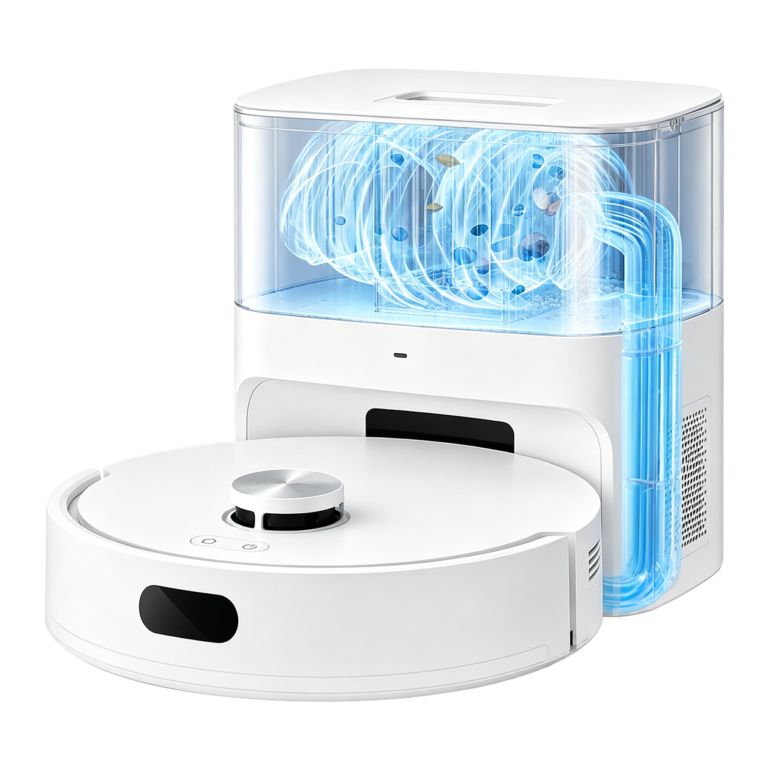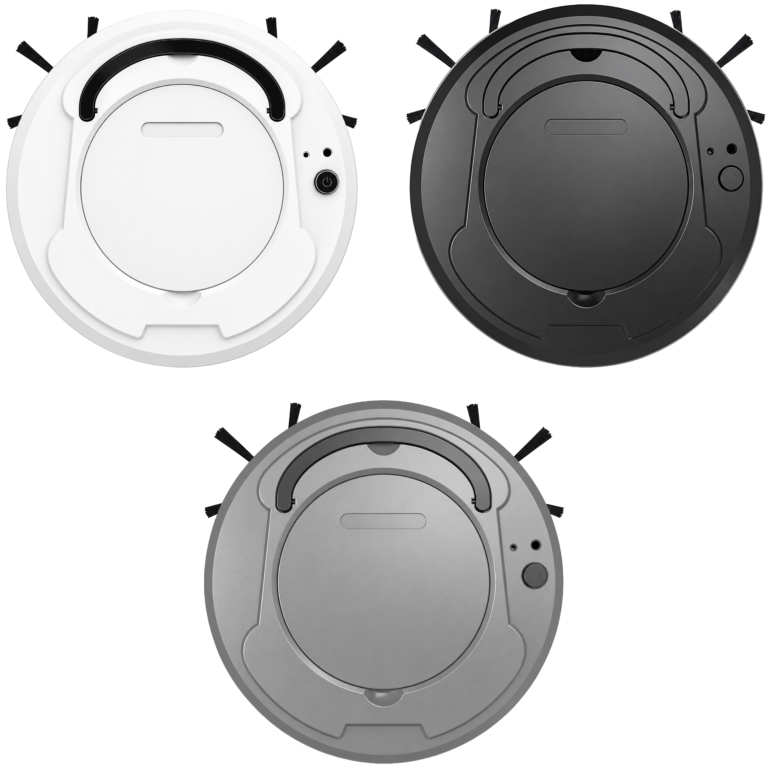
Gyroscope Robot Vacuum UAHRC08: 1200Pa, 510ml, 80min

Order 1,968 units and a 20ft container is full — that ceiling, not suction, is what usually decides this purchase. A gyroscope robot vacuum is a mapping-free cleaning robot that steers by inertial heading and wheel odometry rather than a laser turret. The UAHRC08 pairs 1200Pa suction with a 3.7V 3000mAh cell, roughly 80 minutes of runtime and a 510ml dustbin.
// 01 — Key takeaways
Our Guilin plant runs seven assembly lines with 205 workers and up to 100,000 units a month. Every unit ships with a minimum 12-month warranty — the figures and the certification list are set out in our Trust Center.
Rated suction from the 8.6W high-speed DC motor in this gyroscope robot vacuum — sized for hard floors, low-pile rugs and hotel corridors rather than deep carpet.
Dustbin capacity. Roughly three times the 177ml bin on our entry UAHRC10, which is what changes the daily handling.
Runtime from a 3.7V 3000mAh cell, followed by a five-hour recharge over the 5V-1A input.
Twelve pieces per carton at 0.1658 CBM. A 20ft container takes 1,968 units, a 40ft takes 4,092 and a 40HQ takes 4,800 — straight from our own carton spec.
Per-unit price at the 5,000-piece tier. The catalogue ladder starts at $20.00 and steps down through $18.50 and $18.00.
// 02 — Definition
What is a gyroscope robot vacuum?
A gyroscope robot vacuum estimates its own position from heading change and wheel rotation, then dead-reckons a path from that data. It builds no stored floor plan, carries no laser turret and keeps no room list. On the UAHRC08 the manufacturer calls this pedometer planning, and it produces a straight-line back-and-forth sweep.
How a gyroscope robot vacuum builds its path
An inertial sensor tracks how far the chassis has turned. Wheel encoders track how far it has travelled. Combine the two and the robot knows, approximately, where it stands relative to where it started. The UAHRC08 uses that estimate to run parallel passes across a room instead of ricocheting at random.
The practical result is coverage that looks deliberate. Rows overlap slightly, edges get followed, and a single 80-minute cycle clears an open room without repeating the same square metre eight times.
Why there is no stored map
Dead reckoning drifts. Every wheel slip on a rug edge and every carpet-to-tile transition adds a small error that never gets corrected, because there is no external reference to correct it against. That is why a gyroscope robot vacuum cannot offer no-go zones, saved room names or multi-floor maps.
For a single open floor of 40 to 70 square metres, drift rarely matters. Across four rooms and two hallways it does. That distinction is the honest sales boundary for this model.
Gyroscope robot vacuum versus random-bounce navigation
Our own catalogue makes the contrast concrete. The UAHRC10 is listed as random navigation: it bounces off obstacles and relies on time to achieve coverage. The UAHRC08 is listed as pedometer planning, which is what makes it a gyroscope robot vacuum rather than a random-path unit. Both are rated 1200Pa, so the difference buyers feel is path efficiency, not raw suction.
Two obstacle-avoidance modules and three anti-drop modules handle the physical hazards on the UAHRC08 — furniture legs and stair edges — independently of the navigation logic.
// 03 — Suction & capacity
What do 1200Pa and a 510ml dustbin change?
1200Pa is a mid-range rating that lifts dust, hair, crumbs and grit from hard floors and low-pile rugs. It will not pull embedded debris out of deep carpet. On a gyroscope robot vacuum the 510ml dustbin is the more consequential number day to day, because it sets how often somebody has to touch the machine.
What 1200Pa of suction moves
Pascals describe the pressure differential the fan can generate, not the volume of air it moves. At 1200Pa the UAHRC08 handles the debris load of a tiled kitchen, a laminate corridor or a hotel guest room reliably. Pet hair on a woven rug is the edge of its envelope.
Independent comparison is harder than it looks: IEC/ASTM 62885-7, the dual-logo standard for dry-cleaning robots, explicitly states that its performance data allows comparison between robots only — never against a manually operated vacuum. Pa figures quoted from different test rigs are not interchangeable either.
Why 510ml sets the service interval
A bin that fills mid-cycle stops collecting and starts pushing debris around. At 510ml the UAHRC08 carries roughly three times the volume of the 177ml bin fitted to our UAHRC10 and nearly three times the 185ml bin on the UAHRC13.
In a hotel or serviced-apartment programme that ratio translates directly into housekeeping labour. One emptying per room per day instead of two or three is the difference between a robot that saves time and one that creates a new task.
Noise at 70dB(A) and where it matters
The UAHRC08 is rated at 70dB(A) or below. That is quieter than the 80dB(A) ceiling on the UAHRC10 and louder than the sub-65dB UAHRC13. For daytime cleaning in an occupied office or a hotel corridor, 70dB(A) is workable. For overnight running in a guest room it is not the quietest option we build.
// 04 — Specifications
UAHRC08 specification sheet
The UAHRC08 gyroscope robot vacuum is a 3-in-1 sweep, vacuum and mop robot on a 278mm circular chassis 68mm tall. It draws 8.6W at the motor, runs a 3.7V 3000mAh lithium cell, and is controlled by button or by Bluetooth from a mobile app that handles power, scheduling, direction and cleaning mode.
Full electrical and mechanical specification
UAHRC08 spec sheet
Rev. 2026.09
| Spec | This model | Why it matters |
| Suction power | 1200Pa | Hard floors and low-pile rugs; not a deep-carpet machine |
| Motor power | 8.6W | High-speed DC motor; sets the draw against the 3000mAh cell |
| Battery capacity | 3.7V / 3000mAh | Determines the 80-minute cycle and the transport paperwork |
| Working time | Approx. 80 min | One cycle covers a single open floor, not a whole apartment |
| Charging voltage | 5V-1A | USB-class input; no proprietary dock or high-current supply |
| Charging time | Approx. 5 hours | Caps the machine at about three cycles in 24 hours |
| Dustbin capacity | 510 ml | Sets the emptying interval and the housekeeping labour |
| Noise level | ≤70 dB(A) | Acceptable for daytime occupied spaces |
| Product size | 278 x 278 x 68 mm | 68mm height decides which furniture it can pass under |
| Net weight | 1.028 kg | Light enough for housekeeping staff to carry between rooms |
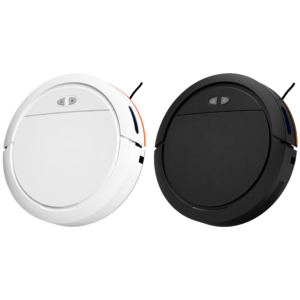
| Product colour | White, Black | Two stock finishes; custom colour runs at the 1,000-unit MOQ |
Catalogue figures are our own factory data; the approved sample governs on any order where a tolerance is contractual. Every line above is measured on the production gyroscope robot vacuum, not on a prototype.
Reading the 8.6W motor rating
8.6W against a 3.7V 3000mAh cell is a deliberately conservative pairing. A higher-wattage motor would raise the Pa figure and shorten the cycle. Our UAHRC10 sits at 7.5W with a 2400mAh cell and delivers the same 1200Pa over a shorter 70-minute run — the same suction, less endurance and a much smaller bin.
Chassis height and furniture clearance
At 68mm the UAHRC08 clears most sofa and bed frames but not the lowest console units. It is taller than our 40mm ultra-slim UAHRC10, which is the model to quote when a client’s furniture stock is the binding constraint. The UAHRC10 is also narrower at 248mm across against the UAHRC08’s 278mm, so it turns in tighter doorways as well as passing under lower frames.
// 05 — Duty cycle
How does 80 minutes of runtime pair with a 5-hour recharge?
Eighty minutes of cleaning followed by five hours of charging gives this gyroscope robot vacuum a 6.4-hour cycle time and a hard ceiling of roughly three runs per 24 hours. That is ample for a household or a single hotel room, and insufficient for a machine expected to work a continuous commercial shift.
The duty-cycle arithmetic
Run 80 minutes, charge 300 minutes, and one complete cycle takes 380 minutes. Divide 1,440 minutes by 380 and you get 3.8 — call it three usable cycles a day with handling time included. Total cleaning output is therefore about four hours in any 24-hour period.
This is the number that disqualifies the model from fleet duty and qualifies it for retail. Sell it as a household machine you move by the pallet, not as a facilities-management asset.
A robot that cleans for eighty minutes and then charges for five is not a fleet machine — it is a household machine you sell by the pallet. Price it, pack it and pitch it that way.
— Mi Lan, Founder, Guilin Use at Home Technology Co., LTD
Matching one charge to floor area
A single 80-minute pass suits an open floor in the 40 to 70 square-metre range: a studio, a one-bedroom apartment, a hotel guest room with its bathroom threshold, or a small office reception. Beyond that the gyroscope robot vacuum runs flat before it finishes, and without a stored map it has no memory of where it stopped.
Two units on alternating charge cycles is the standard answer for larger floors, and at $18.00 per unit at the 1,000-piece tier that is often cheaper than moving a client up to a laser-navigation model.
The 3000mAh cell and transport rules
The lithium cell is a compliance item as well as a spec line. Section 38.3 of the UN Manual of Tests and Criteria requires cells and battery-powered equipment to pass eight tests — altitude simulation, thermal cycling, vibration, shock, external short circuit, impact or crush, overcharge and forced discharge — before they can move by air, sea, road or rail.
We supply the UN 38.3 test summary with the shipping documents. Buyers importing battery-powered appliances for the first time should budget for that paperwork in the customs timeline rather than discovering it at the port.
// 06 — Comparison
How does this gyroscope robot vacuum compare with our other models?
Against our two nearest entry robots, the UAHRC08 gyroscope robot vacuum wins on capacity and endurance rather than on suction. It matches the UAHRC10 on 1200Pa but nearly triples its dustbin; it beats the UAHRC13 fourfold on suction while costing less per unit at volume.
The three-model matrix
| Model | Navigation | Suction | Battery / runtime | Dustbin | Noise | From $/unit |
|---|---|---|---|---|---|---|
| UAHRC08 Featured | Pedometer planning | 1200Pa | 3000mAh / approx. 80 min | 510 ml | ≤70 dB(A) | $16.85 |
| UAHRC10 | Random | 1200Pa | 2400mAh / approx. 70 min | 177 ml | ≤80 dB(A) | $10.24 |
| UAHRC13 | Button control | 300Pa | 1500mAh / approx. 60 min | 185 ml | <65 dB | $28.29 |
Prices shown are the lowest catalogue tier for each model: UAHRC08 at 5,000 units, UAHRC10 at 500 units, UAHRC13 at 3,000 units.
When UAHRC10 is the right call
Quote the UAHRC10 when landed cost dominates and furniture clearance is tight. It is 40mm tall against the UAHRC08’s 68mm, weighs 0.55kg, packs 18 to a carton and loads 10,278 units into a 40HQ. The trade-offs are the 177ml bin, random path logic and an 80dB(A) noise ceiling.
When UAHRC13 is the right call
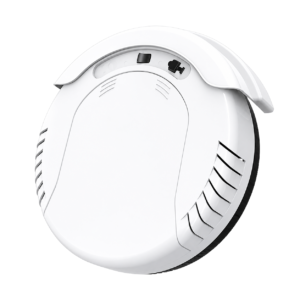
Quote the UAHRC13 when quietness is the specification. It runs below 65dB and is rated for a 90 to 120 square-metre cleaning area with a 5mm climbing ability. Its 300Pa suction is a quarter of the UAHRC08’s, and its 1,000-unit custom MOQ with a 500-unit entry tier makes it the harder model to trial in small volume.
// 07 — Buyer fit
Who should shortlist this gyroscope robot vacuum?
The UAHRC08 gyroscope robot vacuum fits buyers who need a capable mid-tier robot at a mass-market price point: retail chains, hotel and serviced-apartment supply, e-commerce sellers, and private-label programmes. It does not fit anyone specifying multi-room mapping, deep-carpet extraction or continuous commercial duty.
Hotels and serviced apartments
One guest room per cycle is exactly what this gyroscope robot vacuum delivers on its 80-minute runtime, and the 510ml bin means housekeeping empties once per room rather than mid-clean. At 1.028kg net a staff member can carry two units on a trolley round. The 70dB(A) rating keeps it usable during daytime turnover.
Retail and e-commerce programmes
At $18.00 per unit on a 1,000-piece order the UAHRC08 lands in the entry-to-mid retail bracket where a gyroscope robot vacuum sells in volume. The Bluetooth app — power, scheduling, direction and mode — gives the packaging a feature list without the cost of a Wi-Fi module and cloud service.
Private-label and OEM buyers
Custom shells, carton artwork, manuals and accessory packs are all available at the 1,000-unit custom MOQ. Two stock colours, white and black, cover most brand palettes without a tooling change. We are the factory, so specification changes are handled on our own lines rather than through an intermediary.
// 08 — Manufacturing
How we manufacture this gyroscope robot vacuum
Every UAHRC08 gyroscope robot vacuum is built on our own lines in Guilin, Guangxi, where we have manufactured since 2005 — a 15,000 square-metre facility with seven assembly lines and 205 workers, running up to 100,000 units a month. Four production stages carry it from mould to carton, each with its own quality gate.
In-house tooling and molding
The 278mm chassis, the 510ml bin and the brush housings come off our own moulds. Private-label shells and custom colours are cut into the same tooling programme, which is why a bespoke run needs the 1,000-unit MOQ rather than a stock 100.
Motor and PCBA burn-in
The high-speed DC motor and the control board are powered and run before assembly. Burn-in catches early-life electrical failures on the bench, where a board costs pennies to swap, instead of in a customer’s living room after a container crossing.
Suction, drop-sensor and mop testing
Assembled units are tested for the 1200Pa rating, for the two obstacle modules and for all three anti-drop sensors on a stepped rig. The mop plate and water flow are run wet. A unit that misses any gate goes back to the line, not into a carton.
Certification and warranty
We build to CE, RoHS and FCC for export markets and supply the UN 38.3 summary for the lithium cell. Marks are named only where genuinely held, and the applicable set depends on your destination market. Every unit carries a minimum 12-month warranty; the full list is in our Trust Center.
// 09 — Commercial terms
What does it cost at volume, and what fills a container?
The UAHRC08 gyroscope robot vacuum starts at $20.00 per unit and steps down to $16.85 at 5,000 pieces — a 15.75 percent reduction across the ladder. Standard MOQ is 100 units, custom MOQ is 1,000, and a 40HQ container takes 4,800 pieces at twelve per carton.
Price tiers
| Quantity | Discount / unit | Price / unit |
|---|---|---|
| 10+ | — | $20.00 |
| 500+ | $1.50 | $18.50 |
| 1,000+ | $2.00 | $18.00 |
| 5,000+ | $3.15 | $16.85 |
MOQ and lead time
Stock packaging starts at 100 units. Anything carrying your brand — shell print, carton artwork, manual, accessory pack — starts at 1,000, because each of those items needs its own print or tooling run. Typical production lead time is 15 to 30 days from a confirmed order, extending toward the upper end for first-run private-label work.
Container loading math
Each carton holds twelve units, measures 675 x 375 x 655mm, occupies 0.1658 CBM and weighs 20kg gross. Work that up and the container capacities follow directly.
Compare that against the 40mm UAHRC10 at 18 per carton and 10,278 units per 40HQ. Freight per unit is the quiet variable that decides which model actually wins a tender.
Incoterms and payment
We quote FOB China as standard, with EXW and CIF available on request. Payment terms are 30/70 T/T — 30 percent deposit, 70 percent against the bill of lading — and Alibaba Trade Assurance is available for buyers who want an escrowed first order. The single 100-240V design means one SKU covers every plug market with a cable change.
// 10 — FAQ
Frequently asked questions
How does gyroscope navigation differ from LiDAR in a robot vacuum?
How long does the UAHRC08 run on one charge?
How often does a 510ml dustbin need emptying?
What is the minimum order quantity for the UAHRC08?
How many UAHRC08 units fit in a 40HQ container?
Can the UAHRC08 be supplied under our own brand?
// 11 — Verdict
The bottom line
Buy the UAHRC08 gyroscope robot vacuum when you want an orderly cleaning path and a genuinely usable 510ml bin at a mass-retail price. Its limits are honest and fixed: no stored map, 1200Pa rather than deep-carpet suction, and a five-hour recharge that caps it at three cycles a day.
Those constraints are not defects. They are the design choices that let a 3-in-1 sweep, vacuum and mop robot land under $17 per unit at container volume. Buyers who need mapping, no-go zones or 20,000Pa suction should be quoted our laser-navigation UAHRC17 or UAHRC18 instead — and we would rather move you there before the order than after it.
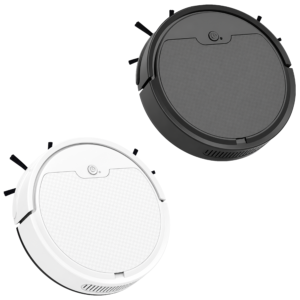
// Featured model — UAHRC08
Gyroscope Navigation Robot Vacuum Cleaner and Mop (UAHRC08)
Gyroscope robot vacuum · 1200Pa suction · 3.7V 3000mAh · approx. 80 min runtime · 510ml dustbin · 3-in-1 sweep, vacuum and mop
Factory direct from $16.85/unit · MOQ 100
Similar products
Ready to order or need a wholesale quote?
Vacuum Cleaners China manufactures these appliances direct from our Guilin, China factory — OEM, private-label and B2B welcome. Tell us your market and volume.